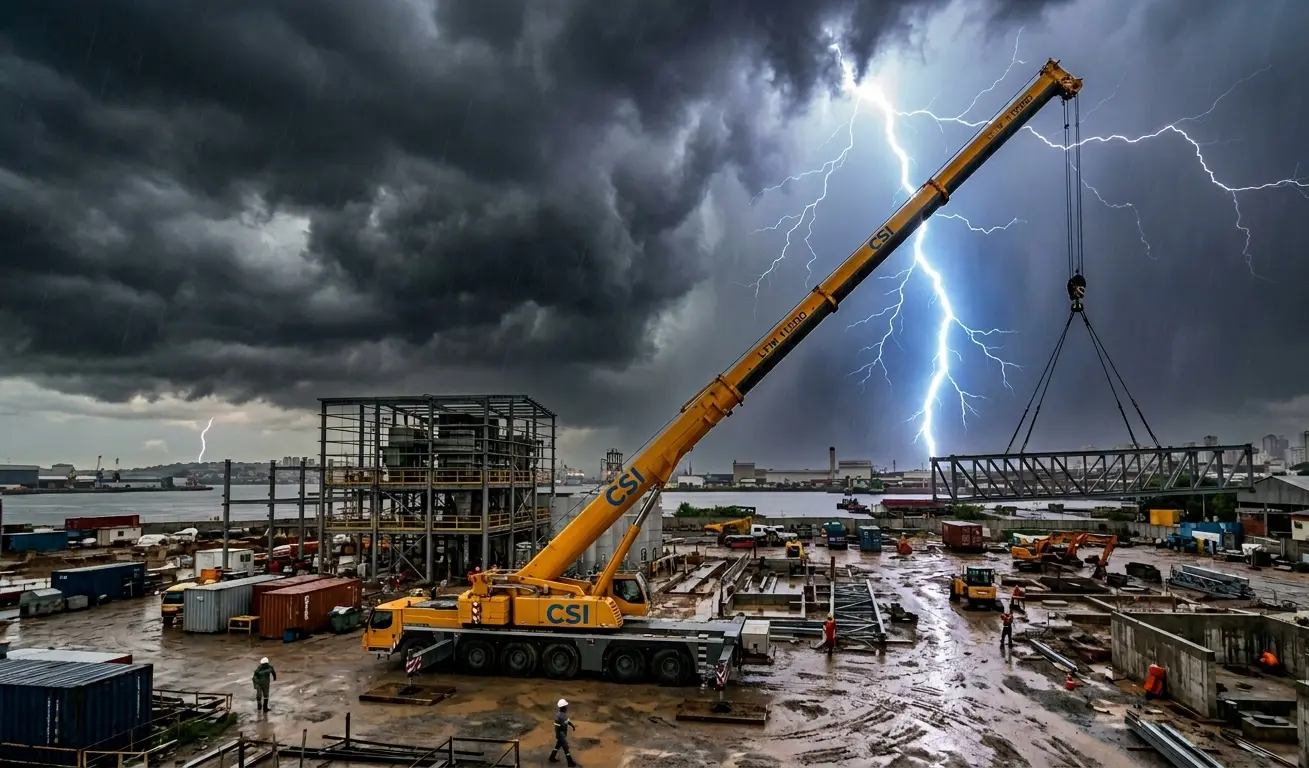
Crane Safety at Year-End: Weather Risks and Operational Pressure
Back to articles
Published on
• by CSI
The end of the year in construction brings a multifactor risk scenario that directly impacts crane operations.
The combination of heavy rain, lightning and human factors significantly increases operational risk.
Safety engineering must act with increased rigor to prevent accidents.
Weather Factor: Rain and Lightning
Load handling requires full attention, especially during critical periods.
At year-end, there is a significant increase in rainfall and lightning activity.
Cranes are tall metallic structures vulnerable to atmospheric discharges.
Human Factor: Reduced Attention
Due to its structure, the crane can attract lightning strikes.
Electrical current can damage systems and endanger lives.
Proper grounding is essential for safe energy dissipation.
Safety Guidelines
Rain reduces soil load-bearing capacity.
Outriggers may sink during operations.
Using larger mats helps distribute loads safely.
Holiday periods impact worker focus and attention.
Safety Checklist
Personal concerns reduce risk perception.
Accumulated fatigue affects reaction time and decisions.
The rush to complete projects increases accident risks.
Teams may ignore safety procedures.
Electrical Protection and Grounding
Operational shortcuts compromise safety.
Specific protocols must be applied during critical periods.
FAQ
Decisions must be based on technical data, not visual judgment.
Applicable Standards
Lightning detection systems improve operational safety.
At the sound of thunder, operations must stop immediately.
Conclusion
No, especially if there is any lightning risk.
Use technical data and prioritize safety.
Stay inside the cabin until energy dissipates.
Copper rods must be used for proper conductivity.
Equipotential bonding prevents electrical hazards.
Is it safe to operate in light rain?
safety, crane, rain, lightning, year end, risk, NR10, NR11, NR12
CSI