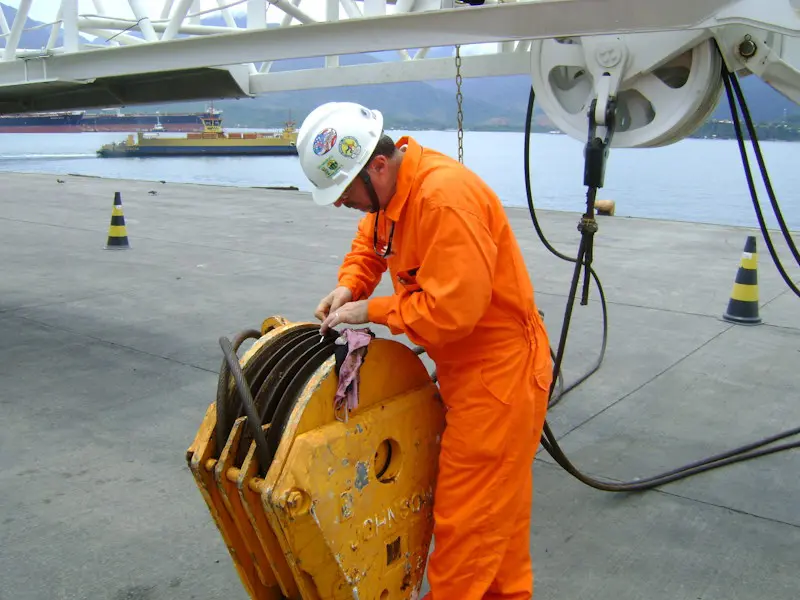
Crane Inspection: Safety, Compliance and Maintenance Engineering
Back to articles
Published on
• by CSI
Crane operation is one of the most critical activities in modern engineering, requiring equipment to be in perfect working condition.
Mechanical or structural failures not only cause material losses but also pose direct risks to human life.
Technical inspection is a strategic tool that allows invisible failures to be detected before they become catastrophic.
Importance of Periodic Inspection
This article outlines inspection protocols, testing methods, and legal requirements for safe operation.
Most crane accidents occur due to undetected failures.
Inspection enables the transition from corrective to preventive and predictive maintenance.
Types of Inspection
Steel undergoes fatigue under repeated load cycles.
Microcracks can propagate quickly and lead to failure.
Deformations compromise stability and structural calculations.
Non-Destructive Testing (NDT)
Sensors such as LMI and limiters must be properly calibrated.
Failures in these systems may allow dangerous overloads.
Inspection levels vary by frequency and depth.
Includes visual and functional checks before operation.
Critical Components
Covers leaks, wire ropes, hooks, and warning systems.
Performed by qualified technical personnel.
Includes torque checks, lubrication, and hydraulic systems.
This is the most comprehensive inspection and often mandatory.
NR-11 and NR-12 Standards
Includes advanced technical testing.
NDT ensures structural integrity without damaging components.
Technical Inspection Report
Used to detect surface and subsurface cracks.
Inspection Checklist
Allows internal inspection and thickness measurement.
Detects internal damage and corrosion.
FAQ
Annually or semiannually under severe conditions.
Immediately stop operation.
No, it is unsafe and not allowed.
References
NR-12 mandates safety systems and protections.
Technical responsibility must be ensured through engineering certification.
The report must include equipment data, methods, and conclusions.
inspection, crane, maintenance, safety, NDT, NR11, NR12
CSI